
In 2020, shortly after Actimo was acquired by Kahoot! I was given an unusually open task: How might we make the platform easier for new customers to adopt without relying on help from the Customer Success team?
Challenge
Actimo’s onboarding process relied heavily on Customer Success Managers. Every new customer required manual platform setup, training, strategy workshops and ongoing support. But with Kahoot!’s ambitions to scale the product to many more customers, this approach was no longer sustainable.
Contribution
- Mapped product friction across the first time experience
- Planned and led customer and internal discovery activities
- Facilitated a cross-departmental workshop
- Prioritised strategic product initiatives and influenced roadmap
- Shared research findings through a company-wide presentations
- Produced design concepts and wireframes sketches for future improvements
- Formulated an initiative addressing the greater architectural issues
- Presented the project outcomes to the CEO
Even though the task landed at my desk, this was very much a shared effort throughout Actimo and Actimo America offices. I also had an incredibly competent leader who provided guidance along the way.
Discovery
I first set out to investigate the customer journey from sales and onboarding to day-to-day administration, to understand why so much manual work was required in the first place. In order to make sure I was learning the right things, I set goals for my research which aligned with the goal of the project: identifying opportunities to make the platform more intuitive, scalable and self-served.
Usability
Investigate opportunities to make the backend more intuitive for new and existing admins
Training
Investigate opportunities to offer initial and general training or help inside the platform
Navigation
Investigate challenges with the current navigation, product architecture and flows
Platform Test
I created a brand-new platform and went through the same journey as a first-time administrator, noting every issue I encountered. This gave me a very clear understanding of where the product created friction and how the process was, which also helped me when I spoke to customers and Customer Success.

Interviews
I interviewed nine existing customers together with a colleague from Customer Success in charge of product training. While she focused on onboarding and training, I focused on the administration experience. To understand the internal perspective, I also interviewed other Customer Success Managers.
Journey Mapping
I facilitated a cross-functional workshop with representatives from Product, Sales, Customer Success and Support. But instead of discussing features, we mapped the journey of a new customer from the first sales conversation to successfully running their employee app. This way, we could identify pains and opportunities not only for a new customer but also in our own departments.

Findings
The research quickly revealed that many of the challenges weren’t only individual usability or interface problems. In general, new platforms relied much too heavily on Customer Success Managers and even involved Marketing.
- Setting up a new platform was a tedious, manual task for Customer Success. It was a lengthy, time consuming process but only required the same clicks every time.
- Every new platform started out as a completely empty shell. Customer Success Manager and clients had to plan out the entire employee app and strategy together—many meetings of several hours, where sometimes reaching agreement becomes the bigger challenge. Also a Graphic Designer from Marketing had to create visuals for the app to make it feel branded.
- The platform offered no onboarding, guidance or training for new administrators. The platform itself wasn’t very intuitive without a Customer Success Manager there to explain the logic and how to structure it.
Opportunity Solution Tree
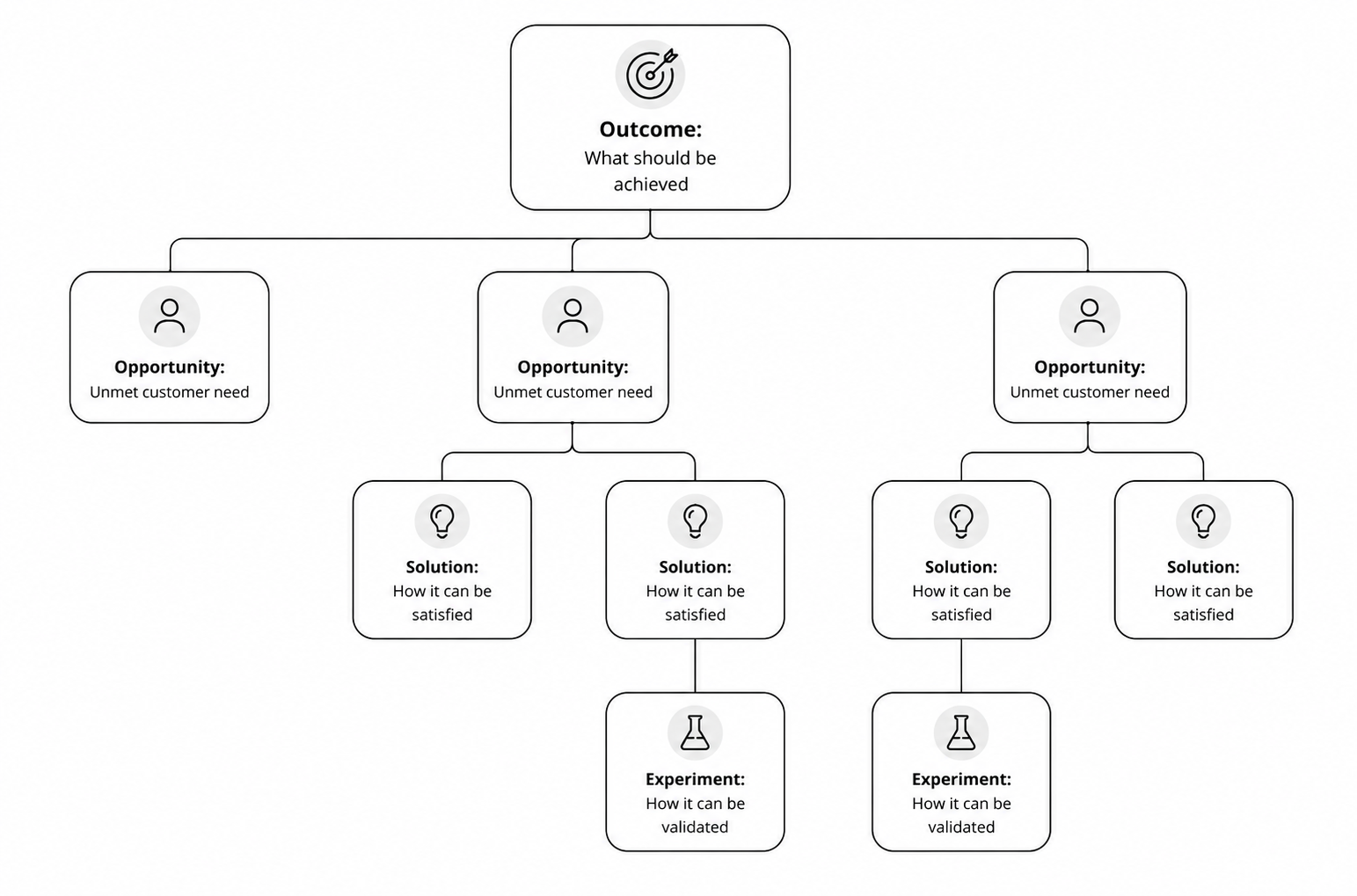
I organised all the product opportunities, ideas and potential solutions from interviews, workshops and my own observations, and made it accessible for everyone. The tree became a way to structure discussions across the teams and helped us move from observations to concrete initiatives.
Strategy
With so many opportunities identified, the next challenge became deciding where to focus, first. I prioritised the opportunities based on estimated user value, implementation effort and strategic importance.
I also facilitated a review with the other departments: sales on how much it would improve sell-ability, and development on how advanced an opportunity would be to implement, customer success on the amount of work saved.
Some improvements were relatively small, such as changing the default feature flags, better welcome emails and a product tour. Other opportunities challenged the product at a much deeper level; platform architecture, navigation and even the relationship between the employee app and the administration system.
Sharing insights
I added all insights into Actimo’s Productboard and tagged them to relevant ideas. I also created a PowerPoint with all the major discoveries, and presented them in an open (online) session, where anyone from the company could join.
Outcome
Updated Roadmap
The work resulted in 15 validated, prioritised and production-ready initiatives ranging from onboarding improvements to larger architectural changes.
I also stressed the importance of fixing the foundational and structural problems sooner rather than later. Even though it wouldn’t be a quick-win, previous experience and gut-feeling told me it was of great importance.
Navigation Redesign
One of the larger projects was redesigning of the administration navigation. It became the new foundation for the platform—and is still in use today.
Unified Design System
I also finally succeeded in convincing the team we had to downgrade from two different Designs Systems for the administration and the employee app, to just one unified, flexible whitelabel-supporting Design System.
Cross-border collaboration
The work shifted conversations away from isolated feature requests and towards the structural changes needed to support a more scalable product. The collaborative approach aligned departments, created unity, and shared knowledge across actual borders.
Learnings
Even though I was hired as a Designer, this project reinforced my opinion that opportunities aren’t necessarily hidden inside pixels alone. It’s important to sometimes press pause on the tasks of everyday work, and zoom out.
It’s important to sometimes press pause on the tasks of everyday work, and zoom out.
By stepping back and looking at the entire system; how customers, internal teams, product architecture and business goals influenced each other, we ended up with a whole backlog of work—really important work—ready to happen.
I also learned that I thrived in being the facilitator and bridge between departments and people—not necessarily as the one with all the answers, but the one who is willing to uncover them, prioritise them, and push them forward.
I’m grateful to all my colleagues at Actimo for the great collaborations and support throughout the project and to leadership for trusting me with it.